Artificial Intelligence (AI) is changing the way we work, learn, and do business. From writing emails to analyzing financial data in seconds, AI is becoming a part of almost every profession. Naturally, this has sparked a common question among commerce and accounting students: Will AI replace accounting jobs?
If you’re pursuing a career in accounting or finance, You need Finzcom’s Finance management course in Kerala you’ve probably come across headlines predicting that AI will automate bookkeeping, tax filing, and financial reporting. It’s easy to feel uncertain when technology is advancing so quickly.
But here’s the good news: AI isn’t replacing accountants, it is changing what accountants do.
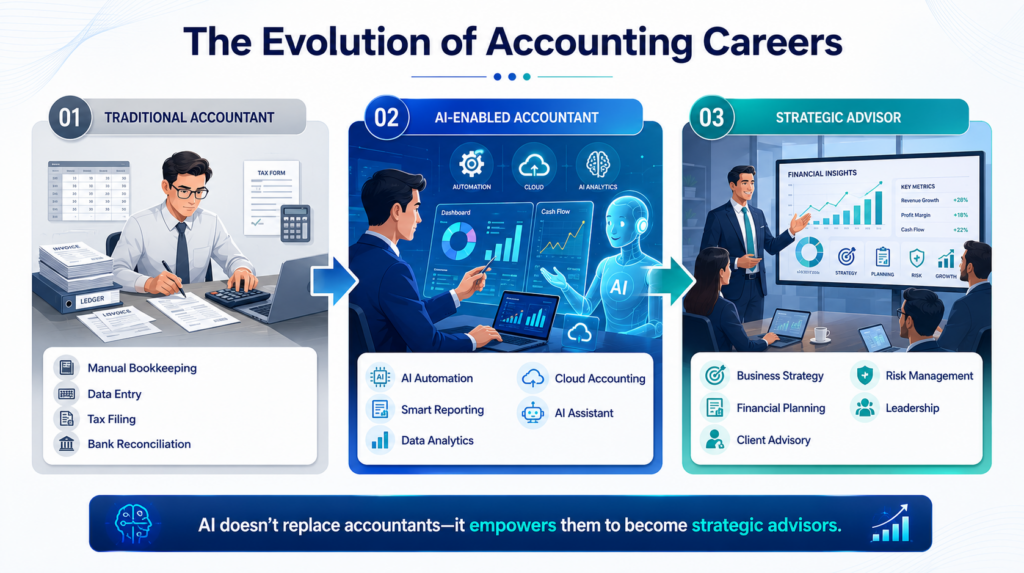
Think about it this way. Years ago, accountants spent hours entering data manually, reconciling bank statements, and organizing receipts. Today, AI can complete many of these repetitive tasks in minutes. Does that mean accountants are no longer needed? Not at all.
In fact, as AI takes over routine work, accountants have an opportunity to focus on higher-value responsibilities like financial planning, business strategy, risk management, and client advisory. The role is evolving rather than disappearing.
If you’re a student wondering whether accounting is still a smart career choice, the answer is yes but success will depend on your willingness to learn new skills and work alongside AI instead of competing with it.
In this guide, we’ll explore how AI is transforming the accounting profession, what tasks it can automate, what it cannot replace, and the essential skills every future accountant should develop to stay ahead.
Will AI Replace Accounting Jobs?
The Short Answer
No, AI is unlikely to replace accounting jobs completely. Instead, it will automate repetitive and rule-based tasks, allowing accountants to focus on strategic decision-making, financial analysis, problem-solving, and client advisory. The future belongs to professionals who combine strong accounting knowledge with digital and AI skills.
That’s the simple answer,but there’s a lot more to the story.
Many people assume that because AI can process data faster than humans, accountants will eventually become obsolete. While AI is incredibly powerful, accounting is much more than calculations and spreadsheets.
Good accountants don’t just prepare financial statements,they interpret numbers, advise businesses, ensure compliance with changing regulations, identify financial risks, and help organizations make informed decisions. These responsibilities require critical thinking, professional judgment, and ethical decision-making,qualities AI simply doesn’t possess.
Rather than replacing accountants, AI is becoming another tool in their toolkit. Just as calculators didn’t eliminate mathematicians and Excel didn’t replace accountants, AI is changing how work gets done while creating opportunities for professionals who know how to use it effectively.
The question, therefore, isn’t “Will AI replace accountants?” It’s “How can accountants adapt to work with AI?”
How AI Is Changing the Accounting Profession
Artificial intelligence is already reshaping accounting firms and finance departments across the world. Tasks that once required hours of manual effort can now be completed automatically with impressive speed and accuracy.
Let’s look at where AI is making the biggest impact.
Bookkeeping Automation
Bookkeeping has traditionally involved recording daily financial transactions, categorizing expenses, and maintaining accurate financial records. While these tasks are essential, they’re also repetitive and time-consuming.
Today, AI-powered accounting software can automatically import bank transactions, categorize expenses, detect duplicate entries, and reconcile accounts with minimal human intervention.
This means accountants spend less time on manual data entry and more time reviewing financial information, identifying trends, and advising clients.
Instead of replacing bookkeepers, AI is helping them become more efficient and productive.
Invoice Processing
Processing invoices used to involve collecting bills, verifying information, entering data into accounting systems, and matching invoices with purchase orders.
AI has transformed this process.
Using Optical Character Recognition (OCR) and machine learning, modern accounting platforms can extract invoice details, validate information, flag discrepancies, and even recommend approvals automatically.
The result?
Businesses process invoices faster while reducing human errors and administrative workload.
Accountants still oversee the process, investigate unusual transactions, and ensure financial accuracy,but they no longer have to perform every step manually.
Expense Management
Managing business expenses can quickly become overwhelming, especially for organizations handling hundreds or thousands of transactions each month.
AI simplifies this by automatically reading receipts, categorizing expenses, identifying duplicate claims, and detecting unusual spending patterns.
For example, an employee can simply upload a photo of a receipt, and AI can recognize the vendor, amount, tax information, and expense category without requiring manual input.
This not only saves time but also improves accuracy and helps businesses maintain better financial control.
Financial Reporting
Preparing financial reports has traditionally required gathering data from multiple sources, organizing spreadsheets, checking formulas, and generating reports for management.
AI dramatically speeds up this process.
Modern accounting platforms can generate real-time dashboards, create automated financial summaries, and highlight significant trends or anomalies that deserve attention.
Instead of spending days compiling reports, accountants can focus on interpreting the insights behind the numbers.
This shift is important because businesses increasingly value professionals who can explain what financial data means,not just produce it.
Tax Preparation
Tax compliance is another area where AI is making a noticeable difference.
AI-powered systems can organize tax documents, identify eligible deductions, calculate liabilities, and flag potential compliance issues before returns are submitted.
This reduces administrative work and minimizes common errors.
However, tax regulations are constantly evolving, and every business has unique financial circumstances. Accountants continue to play a crucial role in interpreting complex tax laws, providing strategic tax planning, and ensuring compliance with local regulations.
In other words, AI handles much of the preparation, while accountants provide the expertise that businesses rely on.
Across all these areas, one thing becomes clear: AI isn’t taking over accounting,it is taking over repetitive tasks.
And that’s actually good news.
As routine work becomes automated, accountants have more opportunities to build meaningful careers centered on analysis, strategy, communication, and business growth. Those who embrace AI will spend less time doing routine work and more time making an impact.
What Accounting Tasks Can AI Replace?
Let’s clear up one of the biggest misconceptions about AI.
People often say, “AI is replacing accountants.” That’s not entirely true.
What AI is actually replacing are tasks, not professions.
Think about your day as an accountant. Some tasks involve following rules and processing data, while others require analyzing situations, understanding business goals, and advising clients. AI performs exceptionally well at the first category, but it still struggles with the second.
Here’s a simple comparison.
AI Can Automate | Human Accountants Are Still Needed For |
Data entry | Financial strategy and planning |
Bank reconciliation | Client advisory and relationship management |
Invoice matching | Business consulting and decision-making |
Expense categorization | Ethical decision-making |
Basic financial reporting | Audit judgment and professional skepticism |
The table tells an important story.
If your career is built solely around repetitive data processing, AI will likely reduce the demand for that type of work. However, if you can interpret financial information, solve business problems, communicate insights, and guide organizations through complex decisions, your value actually increases.
This is why accounting is evolving from a record-keeping profession into a strategic advisory profession.
Instead of spending hours entering numbers into spreadsheets, future accountants will spend more time helping businesses understand what those numbers actually mean.
What AI Cannot Replace
AI is becoming smarter every year, but there are still areas where humans have a clear advantage.
These are the skills that will continue to define successful accountants for years to come.
Critical Thinking
Accounting isn’t always black and white.
Financial decisions often involve uncertainty, incomplete information, and multiple possible solutions. AI can present data, but it cannot think critically about unique business situations the way experienced professionals can.
For example, should a company expand into a new market? Is a sudden increase in expenses a warning sign or a planned investment? These decisions require reasoning, context, and business understanding.
That’s where accountants step in.
Professional Judgment
Accounting standards and financial regulations provide guidelines, but applying those rules isn’t always straightforward.
Two companies may face similar situations yet require completely different accounting treatments based on their business models.
Professional judgment comes from education, experience, and understanding the bigger picture.
AI can recommend options based on historical data, but the final decision,and the responsibility for it still rests with qualified professionals.
Ethics
Imagine an AI system discovers a way to legally reduce a company’s taxes.
Should the company always follow that recommendation?
Not necessarily.
Ethical accounting involves balancing legal compliance with transparency, corporate responsibility, and public trust.
Professional accountants are expected to uphold ethical standards, protect stakeholders, and make decisions that go beyond what algorithms can calculate.
Integrity isn’t something AI can automate.
Regulatory Interpretation
Tax laws and accounting standards change regularly.
Sometimes the wording of a new regulation is open to interpretation, requiring discussions with auditors, legal experts, and regulators.
AI can summarize regulations and highlight updates, but understanding how those rules apply to a specific business still requires human expertise.
This is one reason accountants remain indispensable.
Client Relationships
Numbers tell one story.
People tell others.
Clients don’t just hire accountants to prepare financial statements. They look for someone who understands their goals, listens to their concerns, and provides advice they can trust.
Building relationships requires empathy, communication, and emotional intelligence,qualities that no software can genuinely replicate.
Businesses will always value professionals they can have honest conversations with.
Communication
A great accountant isn’t someone who simply understands financial reports.
A great accountant can explain those reports to people who don’t have a finance background.
Whether you’re presenting financial performance to senior management, explaining tax obligations to a client, or discussing budgets with a business owner, communication becomes one of your most valuable skills.
AI can generate reports.
People still need someone to explain them clearly.
Leadership
As automation becomes more common, accountants will increasingly move into leadership and advisory roles.
They’ll lead finance teams, guide digital transformation projects, improve business performance, and help organizations make informed strategic decisions.
Leadership involves inspiring people, managing change, resolving conflicts, and making difficult decisions.
Those are deeply human abilities that AI simply cannot replace.
10 Skills Every Accountant Needs in the AI Era
So, if AI isn’t replacing accountants, what should today’s students focus on?
The answer isn’t to compete with AI.
It’s to become the kind of professional AI cannot replace.
Here are ten skills that will help you build a future-ready accounting career.
1. AI Literacy
You don’t need to become an AI engineer.
But you should understand how AI tools work, where they add value, and where they have limitations.
Knowing how to use AI responsibly will soon become as important as knowing how to use Excel.
2. Data Analytics
Businesses generate enormous amounts of financial data every day.
The professionals who can analyze that data, identify trends, and turn numbers into actionable insights will always be in demand.
Learning tools like Excel, Power BI, and Tableau can give you a significant advantage.
3. Financial Storytelling
Numbers alone rarely influence business decisions.
Decision-makers want to understand why revenue increased, what caused expenses to rise, and how they can improve profitability.
Future accountants must learn to tell the story behind the numbers.
This is where finance meets communication.
4. Business Advisory
Modern accountants are becoming trusted business advisors.
Instead of simply reporting financial performance, they help companies improve cash flow, manage risks, plan investments, and identify growth opportunities.
Developing a business mindset will make you far more valuable than someone who only focuses on compliance.
5. Critical Thinking
AI provides answers.
Professionals ask better questions.
The ability to evaluate information, challenge assumptions, and solve complex problems will remain one of the most valuable skills in accounting.
6. Communication Skills
Whether you’re writing reports, presenting financial results, or discussing tax strategies with clients, clear communication matters.
Strong communication often separates good accountants from exceptional ones.
7. ERP Software Knowledge
Large organizations rely on Enterprise Resource Planning (ERP) systems such as SAP, Oracle, and Microsoft Dynamics.
Understanding how these platforms manage finance, procurement, inventory, and reporting makes you more attractive to employers.
8. Cybersecurity Awareness
As accounting becomes increasingly digital, protecting financial data becomes everyone’s responsibility.
Understanding cybersecurity basics, data privacy, and fraud prevention is now an essential skill,not just for IT professionals but for accountants as well.
9. Cloud Accounting
Cloud-based accounting platforms have become the industry standard.
Familiarity with tools like QuickBooks Online, Xero, Zoho Books, and other cloud accounting solutions will help you adapt quickly in the workplace.
10. Continuous Learning
Perhaps the most important skill isn’t technical at all.
Technology changes.
Regulations evolve.
New AI tools emerge every year.
The accountants who succeed won’t be the ones who know everything today,they’ll be the ones who never stop learning.
Adopting a lifelong learning mindset will keep your career relevant no matter how much technology changes.
The biggest takeaway?
Your accounting degree is still incredibly valuable. But in today’s world, it’s no longer enough on its own.
Pair your accounting knowledge with digital skills, AI awareness, business thinking, and strong communication, and you’ll position yourself as the kind of professional organizations will continue to need,even in an AI-driven future.
Best AI Tools Every Accounting Student Should Learn
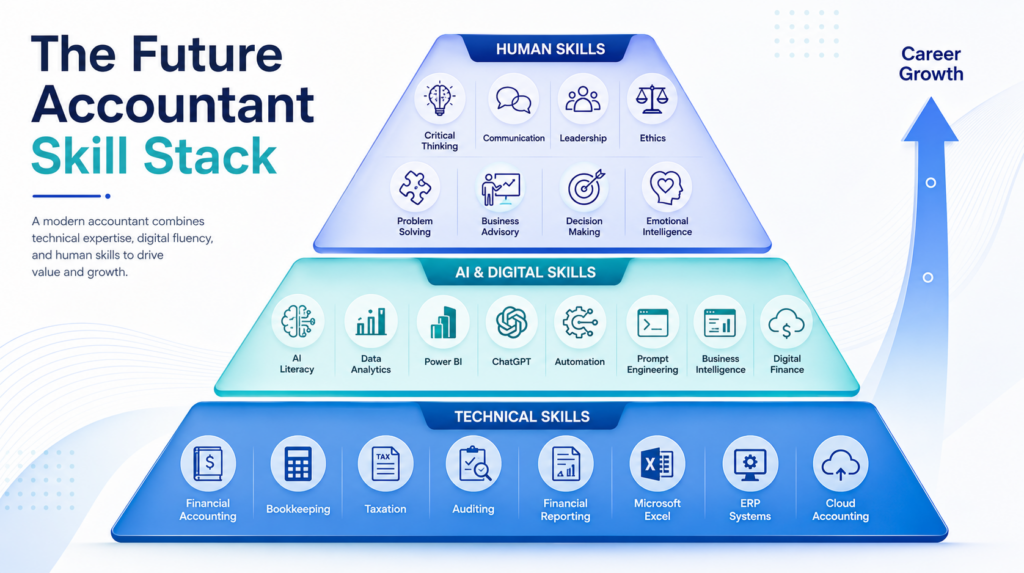
You don’t have to master every AI tool on the market.
Instead, focus on learning the ones that are already making an impact in accounting and finance. Becoming comfortable with these tools will give you a competitive edge during internships, campus placements, and job interviews.
ChatGPT
ChatGPT has quickly become one of the most useful productivity tools for students and professionals alike.
As an accounting student, you can use it to simplify complex accounting concepts, generate Excel formulas, summarize financial reports, brainstorm ideas for presentations, and even practice interview questions.
Just remember one important rule: use it as a learning assistant, not as a replacement for your own understanding.
Microsoft Copilot
If you already use Microsoft Excel, Word, or PowerPoint, Copilot can save you hours of work.
It can help analyze spreadsheets, identify trends, generate charts, summarize reports, and automate repetitive tasks. Since many organizations rely heavily on Microsoft 365, learning Copilot can be a valuable addition to your skill set.
QuickBooks AI
QuickBooks has long been one of the most popular accounting platforms for small and medium-sized businesses.
Its AI-powered features can automate bookkeeping, categorize expenses, reconcile bank transactions, and generate financial insights. Familiarity with QuickBooks is a practical skill that many employers value.
Xero AI
Xero uses artificial intelligence to simplify invoicing, bank reconciliation, and cash flow management.
For students planning to work with startups, SMEs, or international clients, learning Xero can broaden your career opportunities.
Zoho Books AI
Zoho Books combines accounting with automation to make financial management more efficient.
From invoice generation to expense tracking and workflow automation, it’s a great platform to explore,especially if you’re interested in cloud accounting.
Microsoft Power BI
Modern accountants don’t just prepare reports,they create dashboards that help businesses make better decisions.
Power BI enables you to visualize financial data, monitor key performance indicators (KPIs), and present insights in an interactive way.
Data visualization is becoming one of the most sought-after skills in finance.
Excel with AI Features
Despite all the excitement around AI, Excel remains one of the most important tools in accounting.
Learning advanced Excel functions, Power Query, PivotTables, and AI-assisted features will continue to give you a strong advantage in almost any finance role.
Future Career Opportunities in the AI Era
One of the biggest myths surrounding AI is that it reduces career opportunities.
In reality, technology is changing the types of jobs available,not eliminating the need for skilled professionals.
Here are some exciting career paths that are expected to grow in the coming years.
AI Auditor
As businesses adopt AI systems, professionals will be needed to evaluate how these systems make decisions, identify risks, and ensure compliance with regulations.
Financial Analyst
Organizations need experts who can interpret financial data, forecast business performance, and support strategic planning.
AI provides data, but analysts turn that data into business decisions.
Forensic Accountant
Financial fraud is becoming more sophisticated, making forensic accountants more valuable than ever.
AI can identify suspicious transactions, but human investigators are needed to uncover intent, gather evidence, and support legal proceedings.
Tax Consultant
Tax regulations continue to evolve, and businesses still need professionals who can provide strategic advice rather than simply calculate tax liabilities.
Financial Controller
Controllers oversee an organization’s financial operations, ensure regulatory compliance, and support long-term financial planning.
As automation handles routine processes, this role becomes even more strategic.
Chief Financial Officer (CFO)
Tomorrow’s CFOs won’t just understand finance,they’ll understand technology, data analytics, and AI-driven decision-making.
Developing these skills early can prepare students for future leadership positions.
Risk Consultant
Every business faces financial, operational, and cybersecurity risks.
Professionals who can identify, assess, and manage these risks will continue to be in high demand.
Business Advisor
Many accountants are expanding beyond compliance work to become trusted business advisors.
Whether helping companies improve profitability, manage cash flow, or plan investments, advisory services represent one of the fastest-growing areas in accounting.
How Students Can Prepare Today
If you’re still in college, you’re actually in the best position to prepare for the future.
Technology may change, but learning is always within your control.
Here’s a simple roadmap you can start following today.
Learn Excel Really Well
Excel remains the foundation of accounting and finance.
Master formulas, PivotTables, Power Query, dashboards, and financial modeling before moving on to advanced tools.
Learn AI Prompting
Knowing how to ask AI the right questions is becoming a valuable workplace skill.
Practice writing prompts that help you analyze data, explain concepts, summarize reports, and improve productivity.
Think of AI as your assistant,not your replacement.
Build Strong Accounting Fundamentals
No AI tool can compensate for weak accounting knowledge.
Focus on understanding accounting principles, financial statements, auditing, taxation, and cost accounting.
The stronger your foundation, the more effectively you’ll use technology.
Practice Data Analytics
Businesses don’t just need accountants,they need professionals who can interpret data.
Start learning Power BI, Tableau, SQL, or advanced Excel to develop analytical thinking
Earn Industry Certifications
Professional certifications demonstrate your commitment to continuous learning.
Depending on your career goals, consider certifications such as:
- ACCA
- CMA
- CPA
- CA
- Microsoft Excel Certifications
- Power BI Certifications
- QuickBooks or Xero Certifications
Each certification adds credibility and improves your employability.
Gain Practical Experience
Internships, freelance projects, volunteering for NGOs, or even helping a local business manage its accounts can provide valuable real-world exposure.
Employers appreciate candidates who can apply their knowledge in practical situations.
Remember, experience often teaches lessons that classrooms cannot.
Final Thoughts
So, will AI replace accounting jobs?
Probably not.
But it will replace some of the repetitive tasks accountants perform today.
And that’s not something to fear,it’s something to prepare for.
The future of accounting isn’t about competing with artificial intelligence. It’s about combining human intelligence with AI to deliver better insights, stronger business decisions, and greater value.
The accountants who thrive over the next decade won’t necessarily be the ones with the highest grades. They’ll be the ones who stay curious, embrace new technology, and continue learning throughout their careers.
As a student, your biggest advantage isn’t knowing every AI tool available today. It’s developing the adaptability to learn whatever comes next.
The future belongs not to accountants who compete with AI,but to accountants who know how to work with AI.
Frequently Asked Questions (FAQs)
Will AI replace accountants completely?
No. AI can automate repetitive accounting tasks such as data entry, invoice processing, and bank reconciliation, but it cannot replace human judgment, strategic thinking, ethical decision-making, and client relationships.
Is accounting still a good career in 2030?
Absolutely. As AI automates routine work, accountants will increasingly focus on financial analysis, business advisory, risk management, and strategic planning, making the profession even more valuable.
Which accounting jobs are most at risk?
Roles that primarily involve repetitive, rule-based tasks,such as manual bookkeeping, basic data entry, and transaction processing,are the most likely to be automated. However, positions requiring analysis, decision-making, and client interaction remain in high demand.
Can ChatGPT do accounting?
ChatGPT can assist with explaining accounting concepts, summarizing reports, drafting emails, and generating formulas. However, it should not replace professional accountants when it comes to financial reporting, auditing, tax compliance, or regulatory advice.
What accounting skills are AI-proof?
Skills such as critical thinking, communication, leadership, ethical judgment, business advisory, financial analysis, and problem-solving are difficult to automate and will remain essential in the AI era.
Should commerce students worry about AI?
There’s no need to worry,but there is a need to adapt. Students who combine strong accounting fundamentals with digital skills, AI literacy, and continuous learning will be well-positioned for future career opportunities.
Which AI tools should accounting students learn?
Some of the most valuable tools include ChatGPT, Microsoft Copilot, QuickBooks, Xero, Zoho Books, Microsoft Power BI, and advanced Microsoft Excel features.
Ready to Future-Proof Your Accounting Career?
The accounting profession is evolving, and so should your skills. Start building expertise in AI, analytics, cloud accounting, and business advisory today. The earlier you embrace these technologies, the better prepared you’ll be for tomorrow’s opportunities.
After all, the goal isn’t to compete with AI,it’s to become the accountant who knows how to use it better than everyone else.
Join Us
For Enquiry
Have questions or need more information?
Reach out to us, and we’ll guide you on your journey to success
